Tell Atrib (Athribis)
Archaeological Site
Tell Atrib is the site of ancient Athribis, on the northern edge of Banha in Qalyubia, about 50 km north of Cairo near the east bank of the Damietta branch of the Nile. The town was the capital of the tenth nome (province) of Lower Egypt, and the mound at its heart is known locally as Kom Sidi Yusuf. People lived here from at least the Middle Kingdom to the Middle Ages, and the town was at its largest under the Ptolemies and the Romans. Much of it now lies under modern Banha, and what survives is a spread of low mounds and excavated areas rather than standing monuments.
A Delta capital
Athribis was home to Amenhotep son of Hapu, the architect and official of Amenhotep III in the 18th Dynasty, and the king rebuilt the town’s temple at his prompting. Ramesses II later enlarged it, and bases from his obelisks at Athribis are now in the garden of the Egyptian Museum in Cairo. Later rulers built here too: excavators found the foundations of temples from the reigns of Taharqa and Amasis, and in 1946 the tomb of Takhuit, a queen of Psamtik II, was found with other Late Period burials. Early travellers also recorded a small pyramid, the only one known in the Delta, but it has since been lost under fields and houses.
The Ptolemaic and Roman town
From 1957 to 1999 a Polish-Egyptian mission from the University of Warsaw, first led by Kazimierz Michałowski and later by Karol Myśliwiec and Hanna Szymańska, worked at Tell Atrib. South of Kom Sidi Yusuf they uncovered a district of the Ptolemaic town with houses, pottery workshops and a large bath complex, together with hundreds of terracotta figurines, many of them showing Dionysus and Aphrodite. Much of the site has been damaged over the centuries by farmers digging the old mud brick for fertiliser (sebakh), and by the growth of the city.
What you can see
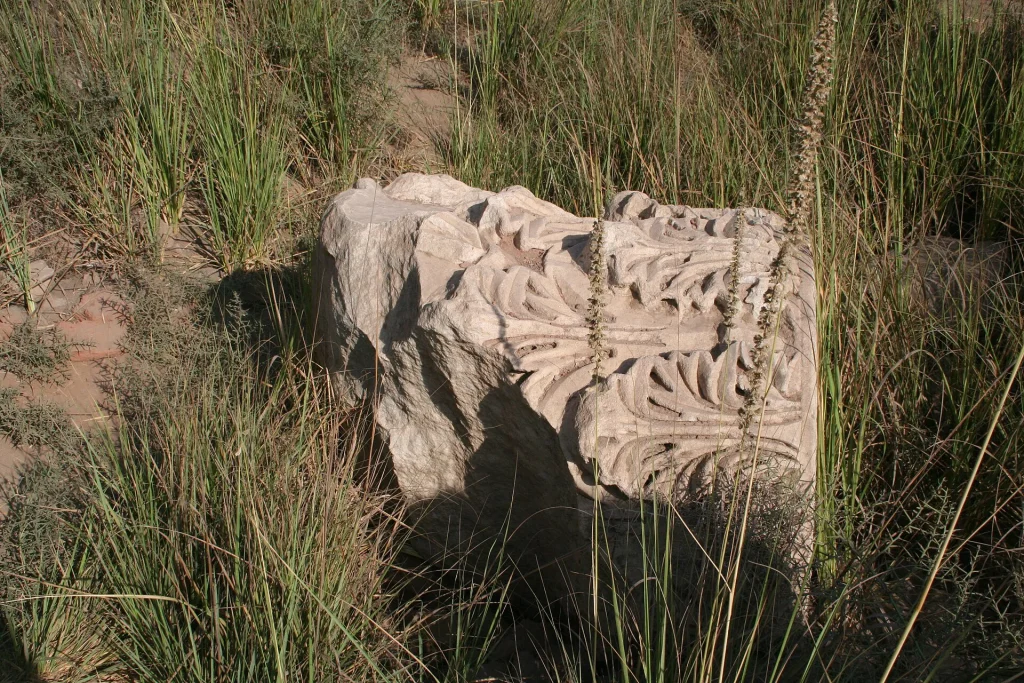
Today Tell Atrib is an archaeological area rather than a visitor attraction. You can see low brick walls, tanks and foundations of the Roman-period town, and scattered fragments of carved stone, surrounded by apartment blocks. There is no visitor centre, no signposted route and no published ticket or opening hours. The finest objects from the site are in museums, so it suits visitors with a particular interest in the archaeology of the Delta.
Visiting tips
- The site is not formally open to tourists. Before you go, ask the antiquities inspectorate for Qalyubia (part of the Ministry of Tourism and Antiquities) or a licensed guide whether you can enter and who to contact on the day.
- Carry your passport, as you may be asked for it by site guards.
- Allow about an hour. There is no shade or facilities, so bring water and a hat.
- Do not climb on walls or pick up pottery or other finds.
Getting there
Banha is on the main railway line north from Cairo, and trains from Cairo’s Ramses station stop there throughout the day. It is also about an hour by road from central Cairo, traffic permitting. From Banha station a taxi or tuk-tuk can take you to Tell Atrib on the northern side of the city; ask for Kom Sidi Yusuf or Tell Atrib.
Last checked November 2026. Sources: en.wikipedia.org, en.wikipedia.org, pcma.uw.edu.pl, heritagedaily.com, commons.wikimedia.org.
Information card
At a glance
Arabic nameتل أتريب
GovernorateQalyubia
Prices and hours change often. Confirm on the Ministry’s official site egymonuments.gov.eg before you go.
Frequently asked questions
Where is Tell Atrib?
On the northern edge of Banha in Qalyubia governorate, about 50 km north of Cairo, near the Damietta branch of the Nile.
What was Athribis?
The capital of the tenth nome of Lower Egypt, a town lived in for well over two thousand years and largest in Ptolemaic and Roman times.
Can I visit Tell Atrib?
It is not formally open to tourists and there is no ticket office. Ask the Qalyubia antiquities inspectorate or a licensed guide about access before you go.
What is there to see at Tell Atrib?
Low brick walls, tanks and foundations of the Roman-period town and scattered carved stone, set among modern buildings. The main finds are in museums.
Who excavated Athribis?
A Polish-Egyptian mission from the University of Warsaw worked there from 1957 to 1999, uncovering a Ptolemaic district with baths and pottery workshops.
How do I get to Tell Atrib from Cairo?
Take a train from Ramses station to Banha, then a taxi or tuk-tuk to the north side of the city.