Historical background
Civilisation began to flourish on the banks of the Nile more than 5000 years ago. From then on, Egypt kept high standards in its economy, central government, architecture and art, and developed complex religious beliefs. The Great Pyramids of Giza reflect all of these.
Location
The Great Pyramids stand on the Giza plateau, part of the Memphite Necropolis, and have kept the names of the kings Khufu, Khafre and Menkaure alive throughout history.
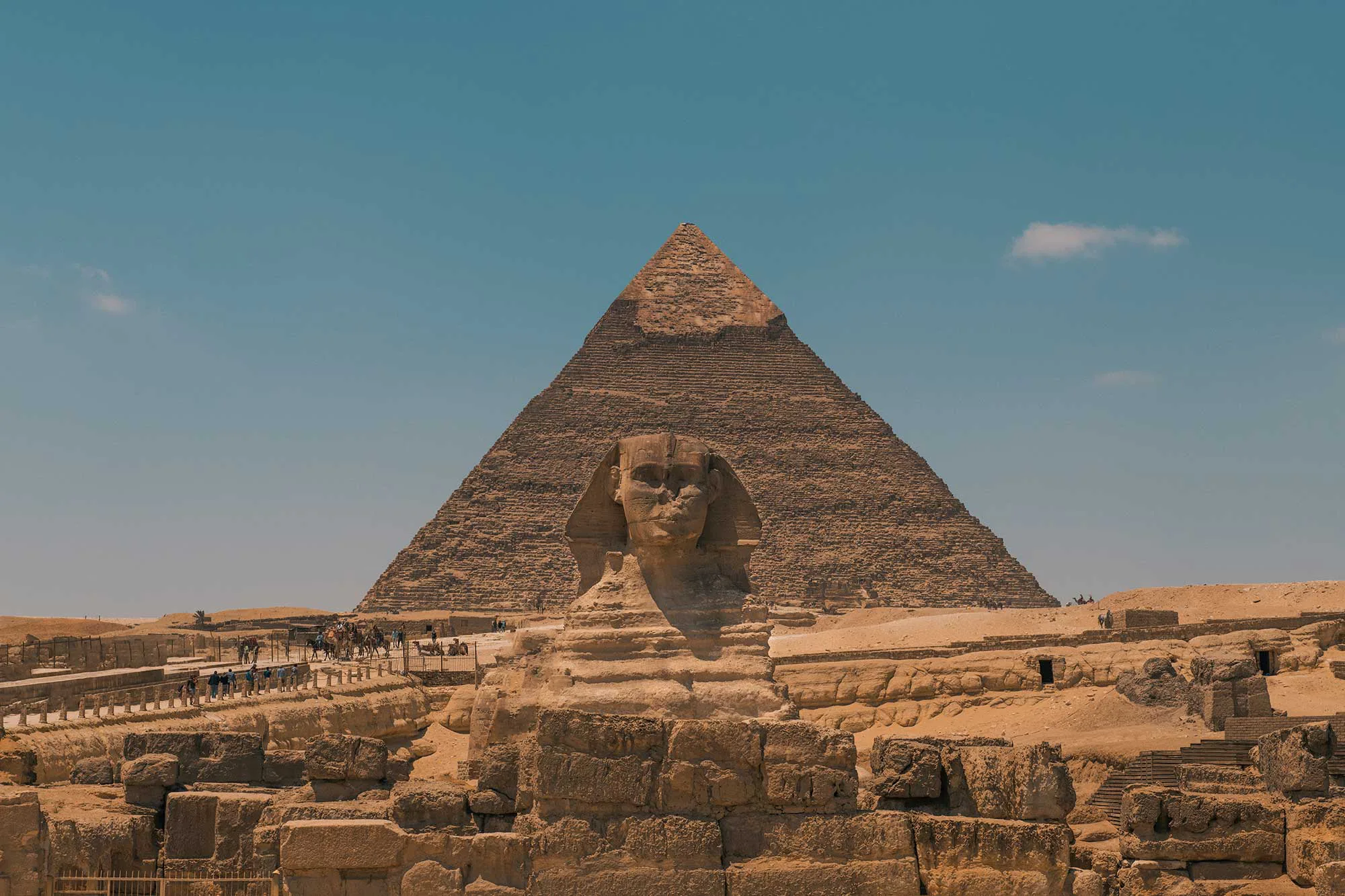
The plateau was chosen for its height, which made the pyramids visible from far away. It was also a quarry for limestone, the main stone used for all three pyramids, the Sphinx and the nearby cemeteries. The fine white limestone quarry of Tura lay close by on the east bank of the Nile, and Tura limestone was used for the outer casing, which you can still see at the top of Khafre’s pyramid.
Pyramid of Khufu
Khufu (Cheops), the second king of the Fourth Dynasty (the age of the pyramid builders), followed his father, King Snefru, and built the largest pyramid known, the only one of the Seven Wonders of the Ancient World still standing. It is 146 metres high, with a base length of 230 metres and sides sloping at 51 degrees. About 2.3 million blocks went into it, each weighing about 2.5 tonnes.
The modern entrance was cut by Caliph El Ma’mun (820 AD), who was trying to find what was hidden inside. The inner passage found there is known as the Grand Gallery. Its corbelled roof is 8 metres high and has five stress-relieving layers. The passage leads to the burial chamber, which holds the king’s red granite sarcophagus.
Pyramid of Khafre
Khafre (Chephren) built his pyramid complex beside the Great Pyramid. It has a valley temple, where the dead king’s body was received, and a paved causeway leading to the mortuary temple, where priests performed the rituals that let the king rest in his burial place deep inside the pyramid.
The Sphinx
Khafre most probably had the Sphinx carved out of the local bedrock. It shows the qualities of an Egyptian king: a human head for thoughtfulness and wisdom, and a lion’s body for strength and courage.
Much later, in the New Kingdom, King Thutmose IV set up the Dream Stela to legitimise his rule over Egypt. It shows him making an offering to the Sphinx, and its text says that ‘Horemakhet-Khepri-Ra-Atum’ crowned him King of Egypt.
Pyramid of Menkaure
Menkaure (Mykerinos) built the smallest of the three complexes. He cased his pyramid with 16 courses of granite, a feature found only here, and added three small satellite pyramids for his queens.
Queens, princes, nobles and even workmen were buried near their kings, with separate cemeteries for each social class.
How the pyramids were built is still debated by archaeologists and scientists. How did the builders lift the heavy stones, and how did they understand and apply complex mathematics? Ramps recently found at a quarry of the same period have brought the ramp theory back into discussion.
Information card
Nazlet El Semman, Haram St., Remaya Square, Giza
Daily: 7 AM-5 PM
At a glance
Arabic nameأهرامات الجيزة وأبو الهول
GovernorateGiza
Foreign adult / student (EGP)700 / 350
Egyptian adult / student (EGP)60 / 30
TicketsEntering a pyramid costs extra: Khufu 1,500 (one source says 1,000), Khafre 280 (one source says 750). Ticket offices at major sites take cards only.
Prices last checkedOctober 2026
EraOld Kingdom
Prices and hours change often. Confirm on the Ministry’s official site egymonuments.gov.eg before you go.
Frequently asked questions
How much is the ticket to Giza Pyramids?
Foreign visitors: EGP 700 / 350 (adult / student). Egyptians: EGP 60 / 30. Prices last checked October 2026; confirm on egymonuments.gov.eg.
Where is Giza Pyramids?
The Giza Pyramids are in Giza governorate, Egypt.
Can I buy tickets online for Giza Pyramids?
Many sites and museums sell tickets on the official portal egymonuments.gov.eg; most also sell at the gate, usually by card only.