Introduction
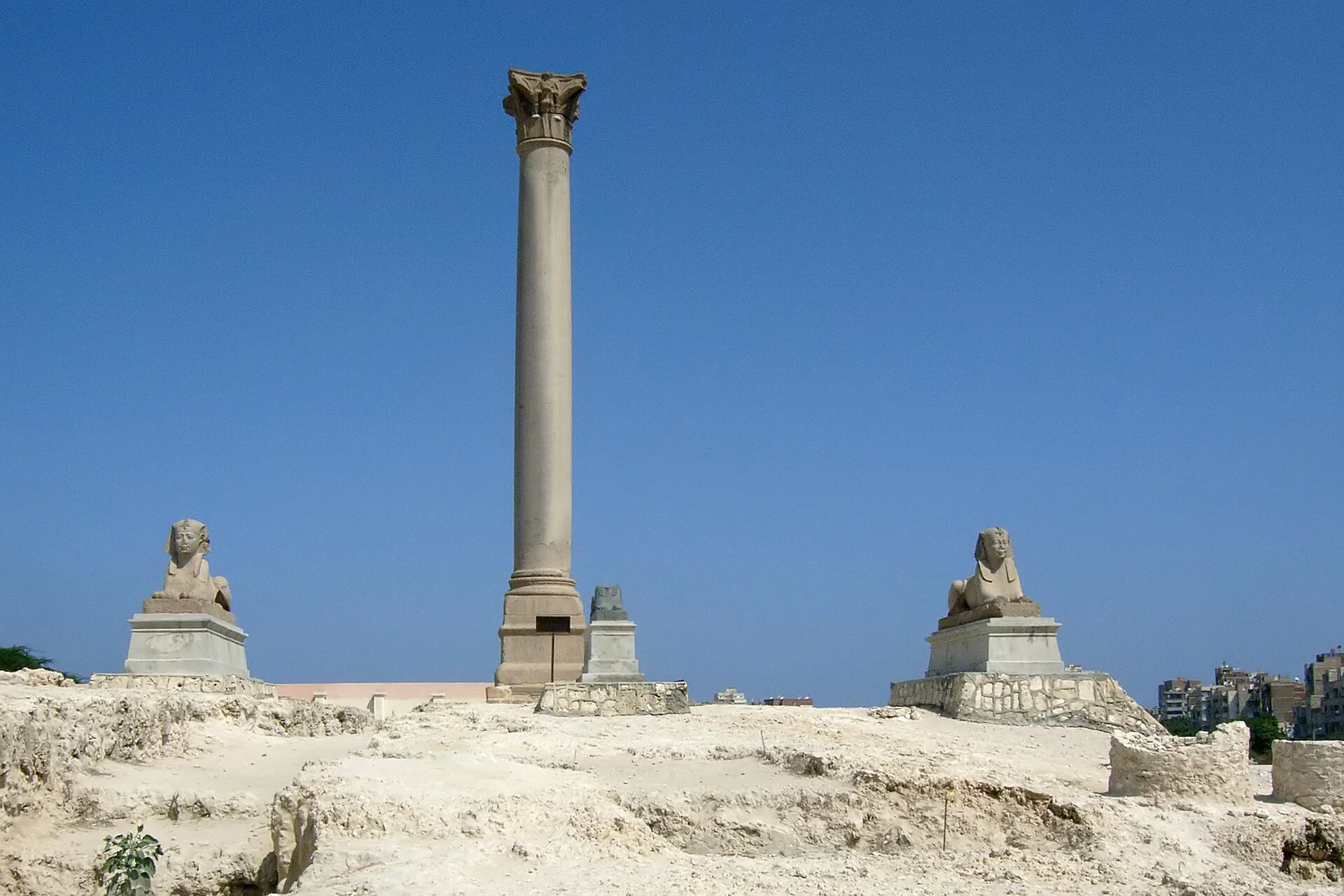
The Catacombs of Kom El Shoqafa (Mound of Shards), just west of Pompey’s Pillar, are a large Roman burial site from the 1st and 2nd centuries AD with more than 300 tombs. They were found by accident in 1900, when a donkey fell through the ground.
Their Greco-Roman style, often mixed with Egyptian elements, is an example of the blend of cultures in ancient Alexandria. The site has a building at ground level that probably served as a funerary chapel, a deep spiral staircase, and three underground levels, 35 m deep, for funeral rites and burials.
The levels of the catacombs
The first underground level has a vestibule with a double exedra, a rotunda and a triclinium. The second holds the main tomb and the corridor around it, with several burials. Below is a third level of tombs, under groundwater.
The vestibule is a short passage from the central shaft to the circular chamber called the rotunda, which leads down to the main burial chamber. The triclinium, a Roman dining hall off the rotunda, was used for meals and celebrations in honour of the dead.
The main tomb
The main tomb is the most lavish burial ever found in Alexandria. It has an antechamber and a burial chamber with three sarcophagi arranged in a cross. Its decoration suggests that the people buried here were of high economic and social status.
The tomb mixes Egyptian and Greco-Roman art and religious ideas. On each side of the doorway, the jackal god Anubis is shown as a Roman warrior.
The antechamber façade is in Egyptian style, with two columns and two pilasters carrying a pediment with a sun disc, images of Horus and two cobras. The entrance to the central chamber, on the other hand, is flanked by Greco-Roman bearded serpents (agathodaemon) holding a winged caduceus, each with a shield bearing the head of Medusa above it.
Hall of Caracalla or Nebengrab
The so-called Hall of Caracalla, or Nebengrab, was found next to the Great Catacomb. It has a court with an altar in the centre, and from the court you reach corridors with burial chambers. Several horse skeletons were found here, so the place is thought to have been used for ritual animal sacrifice. The horses were most probably connected with sport.
The tomb of Tigrane
The Tomb of Tigrane is a few metres from the main entrance to the catacombs. It was found in 1952 on Tigrane Pasha Street (now Port Said Street) and moved to Kom El Shoqafa, near the main entrance. The brightly painted tomb mixes Egyptian and Greek motifs that would have appealed to the varied population of the cosmopolitan city.
The tomb of Wardian
The Tomb of Wardian, a few metres from the Tomb of Tigrane, takes its name from the Wardian district of Alexandria, in the western necropolis. It was rebuilt here and is a small painted chapel that once held a fine statue of the Egyptian goddess Isis.
Sarcophagi in the garden
Several sarcophagi are displayed in the garden, showing the skill of the masons and craftsmen of the period. Their sides are carved with legendary figures and ancient gods in a variety of forms and motifs.
Information card
12, Ras El Tin St. Karmouz, Alexandria Governorate.
9 AM-4 PM
Egyptian: EGP 20
At a glance
Arabic nameمقابر كوم الشقافة
GovernorateAlexandria
EraRoman
Prices and hours change often. Confirm on the Ministry’s official site egymonuments.gov.eg before you go.
Frequently asked questions
Where is The Catacombs of Kom El Shoqafa?
The Catacombs of Kom El Shoqafa is in Alexandria governorate, Egypt.
Can I buy tickets online for The Catacombs of Kom El Shoqafa?
Many sites and museums sell tickets on the official portal egymonuments.gov.eg; most also sell at the gate, usually by card only.