Elephantine Island
Archaeological Site
Elephantine is the largest island in the Nile at Aswan, just below the First Cataract, a little over a kilometre long and facing the city’s Corniche. Its southern end holds the ruins of Abu, or Yebu, the ancient town that guarded Egypt’s southern border with Nubia for some three thousand years, together with the Aswan Museum. The ancient name meant “elephant”, perhaps because of the ivory trade or the rounded grey boulders along its shores. The island is part of the UNESCO World Heritage Site of the Nubian Monuments from Abu Simbel to Philae, listed in 1979.
A frontier town
A fort stood on the island by about 3000 BC, in the First Dynasty, and the town grew into a garrison, customs post and trading base where goods from Nubia, including ivory, entered Egypt. Granite from the quarries on the east bank, where you can still see the Unfinished Obelisk, also passed through. In the fifth century BC the island was home to a community of Judean soldiers and their families, whose letters and contracts in Aramaic on papyrus are among the best-known documents of the period. The German Archaeological Institute has excavated the town for decades, and its work has uncovered houses, streets and temples from almost every period of Egyptian history.
Temples of Khnum and Satet
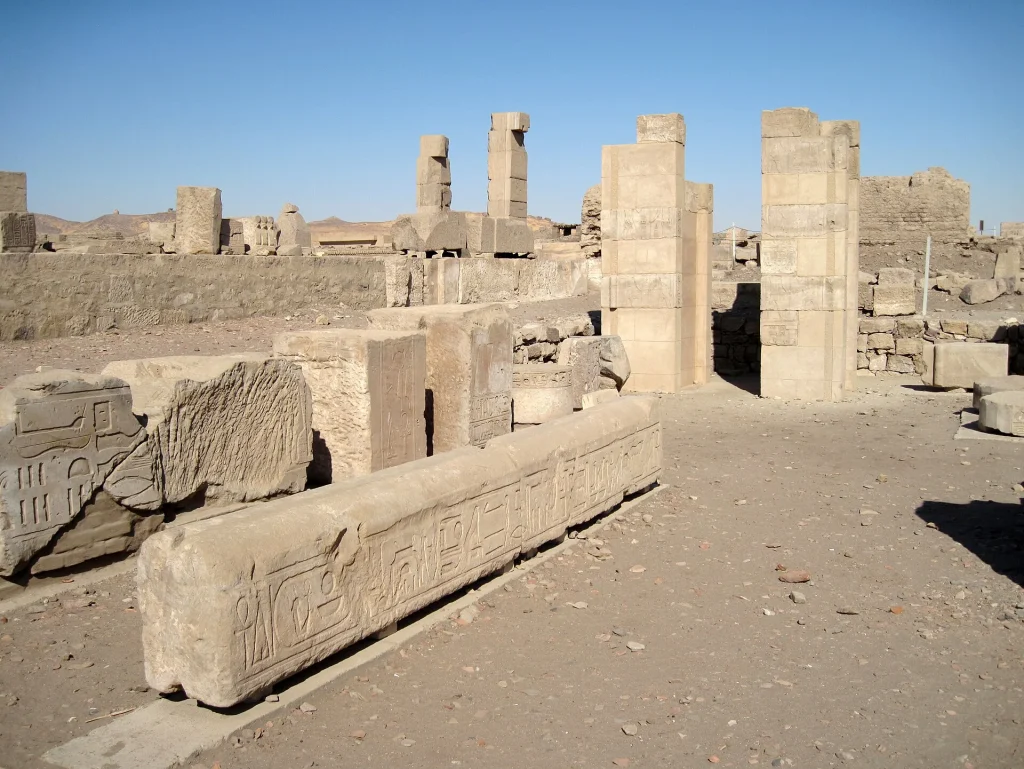
Elephantine was the cult centre of the ram-headed god Khnum, guardian of the source of the Nile flood, and of the goddesses Satet and Anuket. The shrine of Satet began around 3000 BC as a small sanctuary among the boulders and was rebuilt many times. Its temple built under Hatshepsut and Thutmose III has been put back together from more than 500 recovered blocks, and is the most complete building on the site. The great temple of Khnum, rebuilt in the Thirtieth Dynasty under Nectanebo II, survives as a large platform, gateway pillars and rows of inscribed blocks laid out by the excavators. Near the southern tip you can also find a small Third Dynasty step pyramid of granite and the shrine of Heqaib, a local governor of the Sixth Dynasty who was later revered as a saint.
The Nilometers
Two Nilometers measured the height of the annual flood, which set the level of taxes. The better known, linked to the temple of Satet, is a stairway running down to the river with scales cut into its walls in hieroglyphic, Roman and Arabic numerals; it was last rebuilt in Roman times and was still used in the nineteenth century. A second, older Nilometer is a rectangular basin near the southern tip.
The museum and the villages
The Aswan Museum, opened in 1912 in a villa beside the ruins, displays finds from Aswan and Nubia, including the mummy of a sacred ram of Khnum, and a newer annex shows objects from the excavations on the island. North of the ruins, the Nubian villages of Siou and Koti, with their brightly painted houses and narrow lanes, are still lived in, and a path links them across the middle of the island.
Visiting tips
- Allow two to three hours for the ruins, the Nilometers and the museum, and longer if you want to walk through the villages.
- The ruins are open and stony with little shade. Come early, and bring water and a hat.
- The villages are people’s homes. Dress modestly and ask before taking photographs of people.
- Elephantine combines well with a felucca trip to Kitchener’s Island and the Aswan Botanical Garden, and with the Nubia Museum on the mainland.
Getting there
Small public ferries cross to Elephantine from the Corniche in central Aswan in a few minutes, landing near the villages and the museum. You can also hire a felucca or motorboat from the Corniche, which lets you see the island’s river walls and the Nilometer from the water.
Last checked November 2026. Sources: egymonuments.gov.eg, en.wikipedia.org, en.wikipedia.org, lonelyplanet.com, homepages.bluffton.edu, paths-erc.eu.
Information card
At a glance
Arabic nameجزيرة إلفنتين
GovernorateAswan
Foreign adult / student (EGP)200 / 100
Egyptian adult / student (EGP)20 / 10
Opening hoursDaily 8:00–16:00
TicketsPrices for the Elephantine archaeological site from the Ministry of Tourism and Antiquities.
Prices last checkedNovember 2026
Prices and hours change often. Confirm on the Ministry’s official site egymonuments.gov.eg before you go.
Frequently asked questions
How much is the ticket to Elephantine?
Foreign visitors: EGP 200 / 100 (adult / student). Egyptians: EGP 20 / 10. Prices last checked November 2026; confirm on egymonuments.gov.eg.
What are the opening hours of the Elephantine archaeological site?
The Elephantine archaeological site is open daily from 8:00 to 16:00.
How do I get to Elephantine Island?
Take one of the small public ferries from the Corniche in central Aswan, or hire a felucca or motorboat.
What is there to see on Elephantine Island?
The ruins of ancient Abu with the temples of Khnum and Satet, two Nilometers, the Aswan Museum and the Nubian villages of Siou and Koti.
What is the Elephantine Nilometer?
A stairway down to the Nile with scales cut into its walls, used to measure the height of the annual flood; it was last rebuilt in Roman times.
Why is it called Elephantine?
The ancient Egyptian name Abu meant "elephant", perhaps because of the ivory trade or the rounded boulders along the island's shores.