Historical background
Saladin (reigned 1174–1193 AD), the first sultan to rule Egypt, had to face the threat of the Crusaders, so he fortified the cities of the Arab lands, above all the capital, Cairo, regarded as the heart of the Arab lands. The citadel was the most important part of these defences. He built it on the Moqattam Hill, a high point from which the city could be watched and defended against attack.
In 1979 the citadel was added to the UNESCO World Heritage List as part of Historic Cairo, which the listing describes as “the new center of the Islamic world, reaching its golden age in the 14th century AD”.
The citadel was planned as a military city. Qaraqush, Saladin’s vizier, built the military section: a series of fortified round towers and walls that you can still see clearly from Salah Salem Street. Right after Saladin’s death his heirs moved the royal residence into the citadel, finding it a suitable seat from which to rule Egypt.
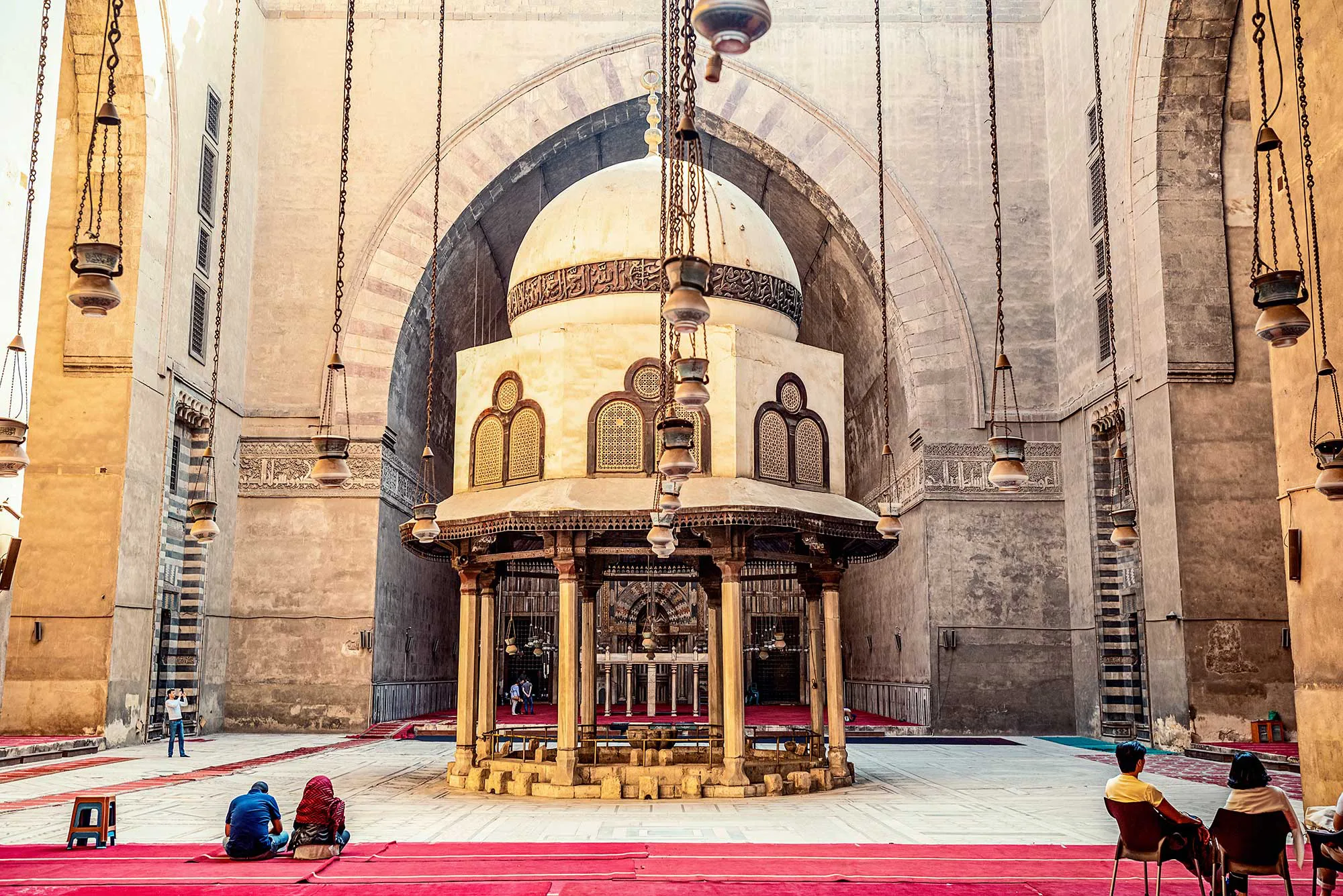
Sultan El-Kamel (1218–1238 AD) went on to build the residential quarter, which is best seen from El-Qal’aa Square. The Mamluks continued in the same way and added to the military complex. El Nasser Qalawoon built a mosque known for its green dome.
Mosque of Mohammed Ali
Muhammed Ali, who came to Egypt and ruled it from 1805 to 1848 AD, built the mosque that can be seen from far across the city. Its design is modelled on the Sultan Ahmed Mosque in Istanbul, Turkey, a choice explained by Muhammed Ali’s Turkish origin, and it is the only building that follows this style.
He built it in memory of his son, who had died, and after his own death he was buried in a mausoleum inside the mosque. Its lavish architecture and decoration set a fashion that his heirs followed and that can be traced all over the country.
Royal palaces inside the citadel
To the south of his mosque Muhammed Ali also built two palaces, El Haramlik Palace and El Jawhara Palace (also called the Bijou Palace). They served as the Pasha’s presidential palace (Divan), where he received guests, met the government and took major decisions.
Both palaces are now museums. El Haramlik houses the National Military Museum, which tells the story of Egypt’s victorious military campaigns from the Pharaonic era to modern times, especially the Youm Kebir War of 1973 and the heroism of the Egyptian soldier. Napoleon Bonaparte described Egyptian soldiers as “the finest soldiers in the world”.
El Jawhara is now a museum of the palace’s original artworks and royal furniture.
Information card
Salah Salem St., El-Qal’aa District, Cairo
Daily: 9 AM-5 PM
Morning
Afternoon
At a glance
Arabic nameقلعة صلاح الدين
GovernorateCairo
Foreign adult / student (EGP)550 / 275
TicketsTicket offices at major sites take cards only.
Prices last checkedOctober 2026
Prices and hours change often. Confirm on the Ministry’s official site egymonuments.gov.eg before you go.
Frequently asked questions
How much is the ticket to Saladin Citadel?
Foreign visitors: EGP 550 / 275 (adult / student). Prices last checked October 2026; confirm on egymonuments.gov.eg.
Where is Saladin Citadel?
Saladin Citadel is in Cairo governorate, Egypt.
Can I buy tickets online for Saladin Citadel?
Many sites and museums sell tickets on the official portal egymonuments.gov.eg; most also sell at the gate, usually by card only.