Historical background
Dendera is the temple of the goddess Hathor and the best preserved of the ancient Egyptian temples built in the Ptolemaic and Roman periods. The site goes back to the Old Kingdom, but its earliest surviving building, the mammisi (house of birth), dates from Nectanebo II, the last native ruler of ancient Egypt.
Structure of the temple
Because it stands on the bend of the Nile at Qena, the temple lies on a north-south axis, at right angles to the river. You enter from the north through a Roman gateway. Inside the enclosure are the main Temple of Hathor, a smaller temple of Isis, a Ptolemaic mammisi, a Roman mammisi, a sanatorium and a sacred lake.
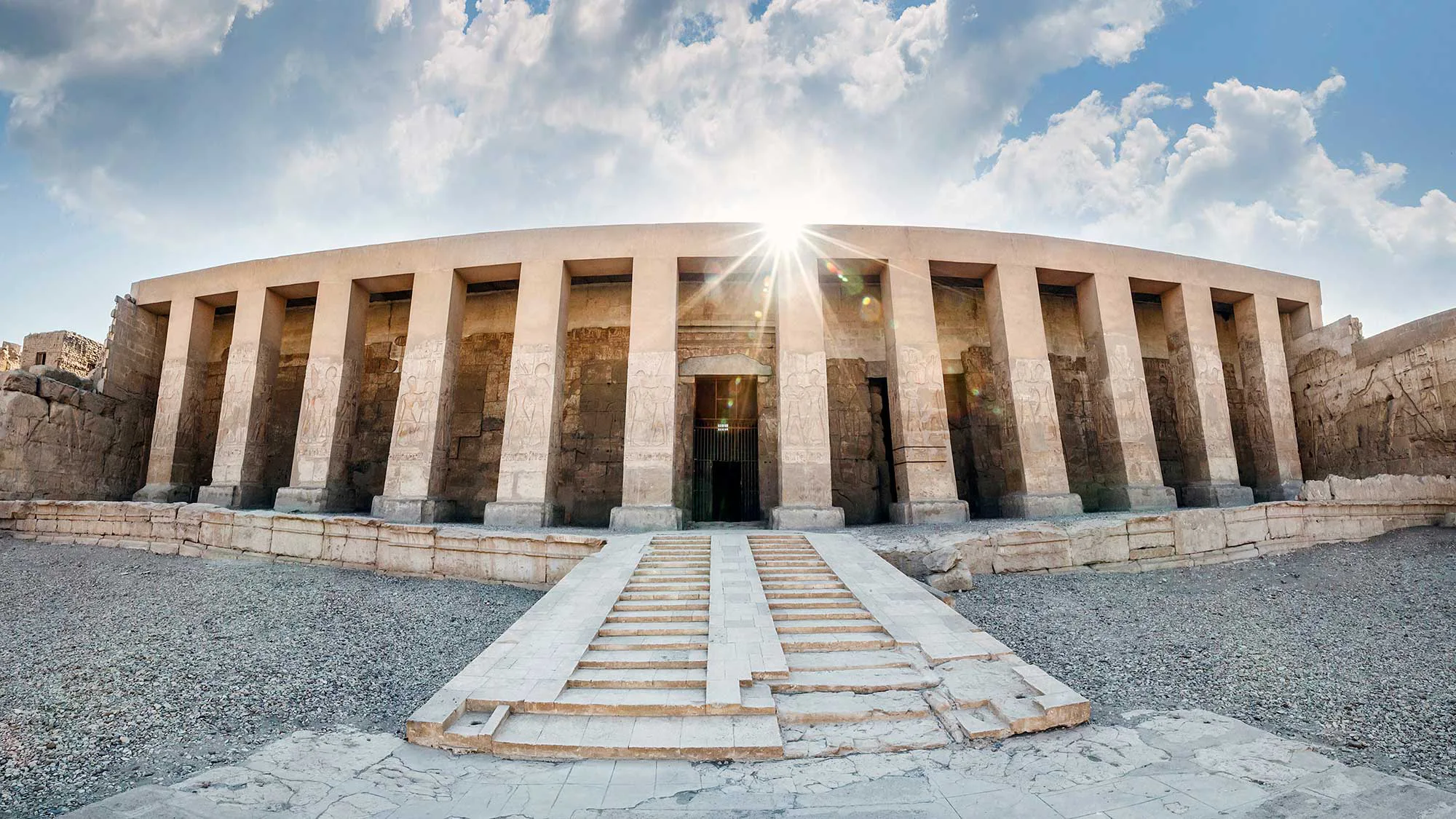
The main temple opens with a large hypostyle hall behind an imposing façade. Its twenty-four columns each carry a four-sided capital with the head of Hathor. The ceiling is known for its zodiac scenes, considered the oldest and best preserved of their kind in an Egyptian temple.
The sky goddess Nut stretches across the whole ceiling, swallowing the sun disc each evening and giving birth to it at dawn. The scene expresses the main purpose of an Egyptian temple: to keep the universe in order and hold back chaos.
Next comes an inner hypostyle hall with six columns, leading to the inner part of the temple. The holiest area has eleven shrines to different gods, among them the holy of holies, the sanctuary of Hathor, the owner of the temple.
The inner hypostyle hall leads to an offering hall and then to the Hall of the Ennead, with shrines for the statues of the gods who wait for the mistress of the house, Hathor, to appear.
Staircases to the east and west of the offering hall lead up to the roof. Their walls show the king followed by the high priests carrying Hathor’s shrine. On the roof is a group of chapels to Osiris, with scenes of his death, mummification and resurrection.
Crypts are built into the walls and under the floors around the inner temple. They held the temple’s treasures and its archives: records for dating the temple, endowments, offerings, the priests’ personal belongings and temple property.
The temple is famous for its religious scenes, but its empty, uninscribed cartouches also say something about Ptolemaic politics: reigns were very short and sometimes overlapped, which led to this unusual feature. The outer walls show Queen Cleopatra VII and Caesarion, her son by Julius Caesar, worshipping Hathor.
Temple of the goddess Isis
South of the main temple is the Iseum, a temple to Isis built as a birth temple for the goddess. Its plan is unusual: the outer part faces north, while the sanctuary is turned towards the main temple of Hathor, probably as a mark of respect.
House of birth (mammisi)
The complex has two birth houses, or mammisi, small chapels attached to the temple and linked with the birth of Hathor and her son Ihy. The Ptolemaic mammisi was first built by Nectanebo II and renovated by several Ptolemaic kings. The other was built and decorated by several Roman emperors, including Augustus and Trajan.
Sanatorium
West of the main temple stands the mudbrick sanatorium, dedicated to Hathor as goddess of healing. Visitors could bathe in the sacred waters and spend the night here. It is the only building of its kind found in Egypt.
The enclosure was later used for a Christian basilica, of which only ruins remain. The temple ceiling is heavily blackened with soot from a long period when people lived in the building.
Information card
Al Ashraf Al Bahariyyah, Dandarah, Qena
Sat- Thurs: 9 AM-4 PM
At a glance
Arabic nameمعبد دندرة
GovernorateQena
EraPtolemaic
Prices and hours change often. Confirm on the Ministry’s official site egymonuments.gov.eg before you go.
Frequently asked questions
Where is Dendera Temple Complex?
The Dendera Temple Complex is in Qena governorate, Egypt.
Can I buy tickets online for Dendera Temple Complex?
Many sites and museums sell tickets on the official portal egymonuments.gov.eg; most also sell at the gate, usually by card only.