Deir El Bahari
Archaeological Site
Introduction
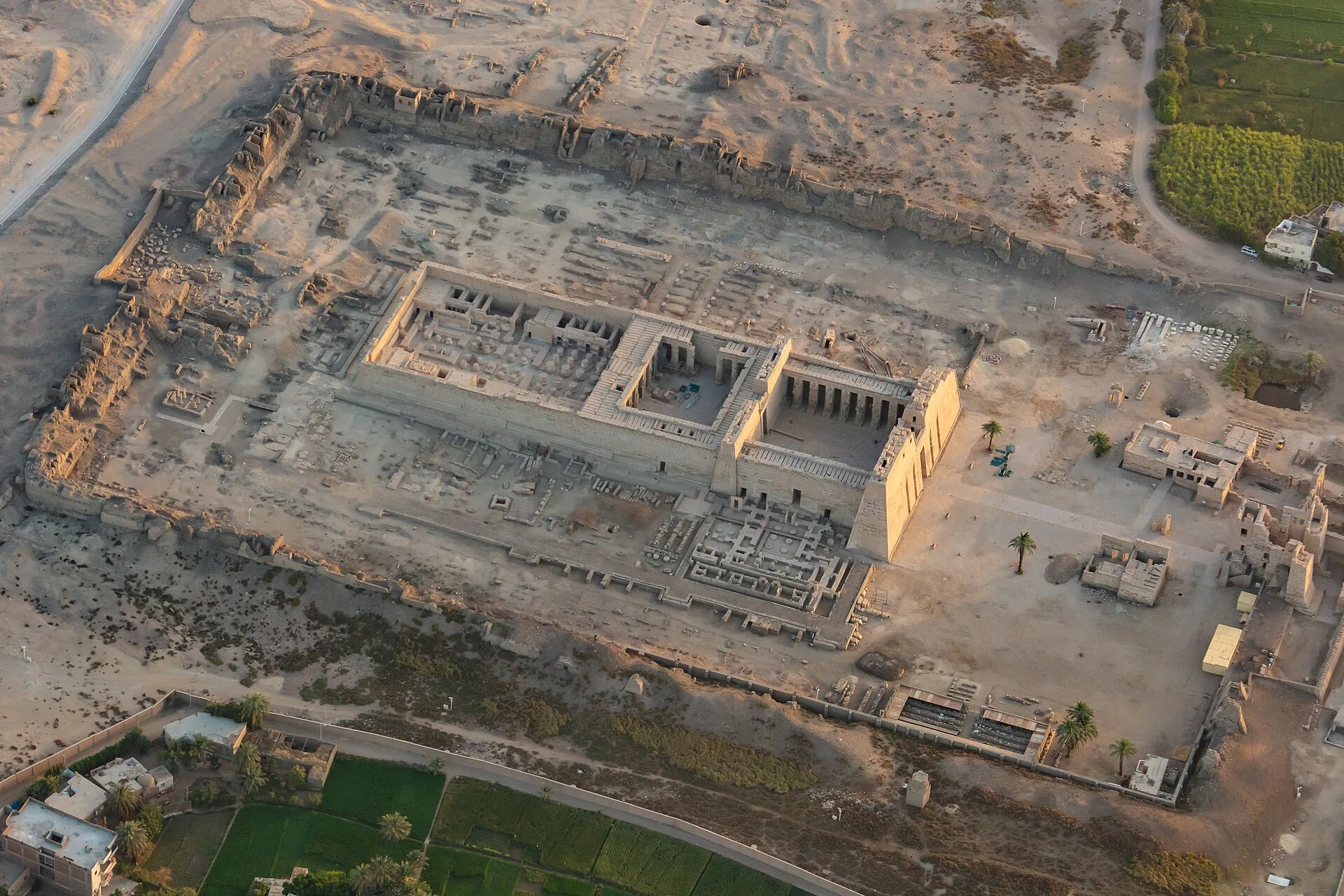
Deir El Bahari is a group of “million-of-years” temples and tombs on the west bank of the Nile, opposite the Temple of Amun at Karnak. A Coptic monastery later occupied the temple area, and the site’s modern Arabic name comes from it.
The first king to build a temple here was Montuhotep Neb-heptere, founder of the Middle Kingdom. His terraced, rock-cut temple became the model for the later temples of Hatshepsut and Thutmose III.
Queen Hatshepsut’s temple is the largest and best preserved of the three. She built her Djesr Djesru, “Sacred of the Sacreds”, mainly to commemorate her divine birth and the great expedition to Punt. The third temple, of King Thutmose III, was squeezed in between and behind the temples of Montuhotep and Hatshepsut.
The temple of Montuhotep Nebhepetre
The temple of Montuhotep Nebhepetre was the first mortuary temple built in the great bay of Deir El Bahari, and it was also the king’s tomb. A processional causeway led up from a small valley temple to a great court lined with sycamore trees.
The ramp to the upper terrace had colonnades along its sides, and the upper terrace had a colonnade on three sides. There a forest of columns surrounded a large square structure that is thought to be the base of a pyramid.
The inner part of the temple was a columned court, beneath which lay the entrance to the king’s rock-cut tomb. At terrace level, a hypostyle hall ended in the sanctuary of the royal cult, with a statue of the king in a niche cut into the rock face. Much of this area is now destroyed.
In 1900 Howard Carter’s horse stumbled into the rubble-filled mouth of a shaft in the great court, which is why the shaft is called Bab el-Hosan, “Gate of the horsemen”. The sloping shaft leads to unfinished rooms thought to have been built as the king’s tomb, but it was later turned into an Osirian cenotaph. Carter also found a linen-wrapped statue of King Montuhotep, now in the Egyptian Museum.
The temple of Hatshepsut
Rock falls from the cliff above gradually destroyed most of the temples at Deir El Bahari, but the Polish-Egyptian mission has reconstructed the temple of Hatshepsut.
The temple was built by Sennenmut, a nobleman, chancellor and architect of the royal court under Queen Hatshepsut. Construction took 15 years, and the plan was substantially modified several times during that period.
A long avenue of sphinxes led to the entrance and on to the great court, where the roots of ancient trees can still be seen. The trees were brought from Punt during the queen’s expedition.
The temple rises in several levels: 3 broad courts separated by colonnades, linked by ramps and enclosed by a dressed limestone wall. On the portico of the first terrace, the northern side shows the marshes of Lower Egypt and the southern side shows the great granite obelisks being transported to Upper Egypt.
The southern side of the second portico carries the reliefs of the famous expedition to Punt (perhaps southern Sudan or Eritrea). They begin with Egyptian boats sailing south and the expedition being received by the king and queen of Punt. Soldiers carry myrrh trees, electrum, ebony and other goods, the boats are loaded and sail back to Egypt, and the cargo is presented to Hatshepsut, who in turn offers it to the god Amun.
On the northern side of the second portico, birth scenes show the queen’s divine conception. When her husband, King Thutmose II, died, Hatshepsut acted as regent for her young stepson Thutmose III. Within a few years she took the throne herself, and she claimed divine birth to confirm her legitimacy as a woman pharaoh.
The Hathor chapel, with its own entrance, lies at the southern end of the second colonnade. A vestibule with Hathor-headed pillars leads to a hypostyle hall on 12 columns and then to inner rooms decorated with scenes of the Beautiful Feast of the Valley and of Hatshepsut with Hathor.
At the northern end of the same colonnade is a smaller chapel of Anubis, god of embalming and guardian of the cemetery, who was usually shown with a man’s body and a jackal’s head.
The entrance portico of the upper terrace is lined with Osiride statues. It opens onto a columned court that leads to the rock-cut sanctuary of Amun, the innermost part of the temple.
On one side of the columned court is a chapel of the royal cult. On the other is a chapel of the solar cult, made up of an open court with an altar and a small annexe.
The temple of Thutmose III
The temple of Thutmose III was discovered in 1961, between the monuments of Hatshepsut and Mentuhotep. Dedicated to Amun, it followed the same design as Hatshepsut’s temple, with a series of ramps and terraces, and was intended to replace it.
Information card
Western bank of the Nile, Luxor Governorate.
7 AM-5 PM
Egyptian: EGP 20
At a glance
Arabic nameمعبد حتشبسوت
GovernorateLuxor
EraNew Kingdom
Prices and hours change often. Confirm on the Ministry’s official site egymonuments.gov.eg before you go.
Frequently asked questions
Where is Deir El Bahari?
Deir El Bahari is in Luxor governorate, Egypt.
Can I buy tickets online for Deir El Bahari?
Many sites and museums sell tickets on the official portal egymonuments.gov.eg; most also sell at the gate, usually by card only.