Historical background
Luxor Temple stands on the east bank of the Nile in the middle of Luxor. It was dedicated to the god Amun, his wife Mut and their son Khonsu, the moon god, who together formed the Theban triad. It was probably built on the site of a smaller Middle Kingdom shrine to Amun, and its earliest surviving parts date from the 14th century BC (the 18th Dynasty of the New Kingdom). In ancient times an avenue of sphinxes linked it to the Karnak temples. The temple contains a barque shrine built by Hatshepsut and Thutmose III, but it is mainly the work of Amenhotep III, who built it to prove his divinity. Tutankhamun, Horemheb, Ramesses II and Alexander the Great all added to it.
After Amenhotep III died, his son Akhenaten moved the capital away from Thebes (Luxor) and building stopped. Under Tutankhamun, one of Akhenaten’s successors, the old religion and its priests returned and work on the temple began again. Over time the temple filled with debris until only the tops of the columns showed, and houses, villas and the mosque of Abu ‘I-Haggag were built on top.
When excavations began in the nineteenth century, the houses were removed bit by bit, but the mosque was left in place because its annual Abu ‘I-Haggag festival is one of the most popular in Upper Egypt. Future excavations may reveal the temple’s original foundations.
The temple was once called ‘Ipet-resyt’, ‘the southern Opet’, and was the focus of the Opet festival, which linked the Karnak and Luxor temples. The festival was religious, but it also helped to uphold the king’s divine role.
Structure of the temple
The processional way
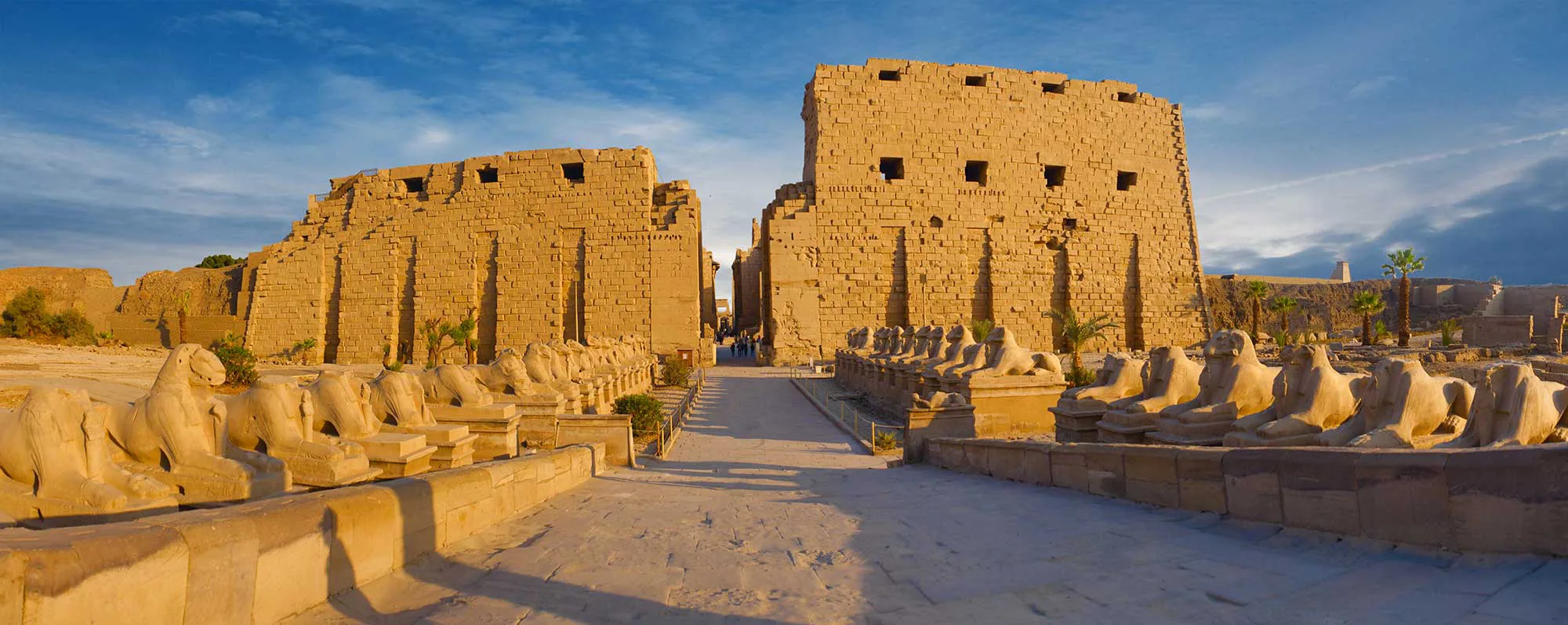
What remains of an avenue of sphinxes follows the processional way between Luxor Temple and the Karnak temples. Nectanebo I set up this 200 m avenue of human-headed sphinxes, replacing the original ram-headed sphinxes of Amenhotep III, when he built an enclosure wall around the precinct.
The main entrance
Two huge seated statues and three standing statues of Ramesses II mark the entrance, along with a single obelisk. On its base, four baboons greet the sun god Re. The second obelisk was given to King Louis-Philippe I of France (1773–1850 AD) and now stands in the Place de la Concorde in Paris.
The pylon and the Ramesside court
King Ramesses II built the pylon, two stone towers marking the main entrance. It carries military scenes of Ramesses II at the Battle of Kadesh (1274 BC), while the court is decorated with scenes of his many sons.
The Ramesside court was built around the 18th Dynasty barque shrine of Queen Hatshepsut, so it does not follow the temple’s main axis but turns slightly to the west. Double rows of columns line the court, and entrances on the east and west sides were made for the Opet processions and for ordinary people.
Eleven colossal statues of Ramesses II stand between the southern columns of the court. The court also contains Roman and Christian remains, and in the 13th century the Abu El-Haggag Mosque was built on top of the Byzantine church.
The colonnade
Two seated colossi of Ramesses II mark the way from the Ramesside court into the colonnade. Amenhotep III built the colonnade, and his grandson Tutankhamun decorated its walls with scenes of the Opet festival. Tutankhamun’s cartouches were later replaced with those of Horemheb. Two rows of seven papyrus columns, each 21.2 metres high, held up the roof.
The open court
Amenhotep III built and decorated the open court, which is surrounded by double rows of papyrus-bud columns. During the Opet festival the king appeared to the people here after receiving the divine powers of the gods. In 1989 a cache of 26 statues of gods and New Kingdom kings was found in the court.
The hypostyle hall and Theban barque shrines
The hall has four rows of papyrus columns; its roof has not survived. A doorway on the east side leads to a small mudbrick palace, and the west side led to the priests’ living quarters. At the south end, a portico holds separate barque shrines for the Theban triad: Amun-Re, Mut and Khonsu.
Chamber of the divine king
This chamber once had eight columns, which were removed at the beginning of the fourth century AD (Roman Period in Egypt). Roman paintings of the emperors were later painted over the coronation scenes of Amenhotep III. A Roman niche blocked the entrance to the rear of the temple, and a modern entrance has been opened through it. Two chapels open off either side of the chamber: the Royal Barque Shrine and the Royal Ka Shrine.
The chamber of the divine king leads to an offering vestibule and then to the barque shrine of Amenhotep III. The shrine originally had four columns, but Alexander the Great removed them and built a richly decorated red granite shrine. The portable image of Amun-Re stayed here during the Opet festival.
Birth room and coronation room
A doorway in the north-east corner of the sanctuary leads to two private rooms, the Birth Room and the Coronation Room. Their scenes tell the story of the divine birth of Amenhotep III, from his conception by Amun-Re and Queen Mutemwiya to the god Khnum shaping the king and his royal ka on a potter’s wheel.
Amenemopet sanctuary
The southern Opet is the sanctuary of Amenemopet, the particular form of Amun worshipped at Luxor Temple. It had four columns and probably a place for the statue of the god. Amenhotep III built the hall, and Alexander the Great claimed to have restored it to its original state.
Information card
Eastern Thebes, Nile Corniche, Luxor
Sat- Thurs: 9 AM-5 PM
At a glance
Arabic nameمعبد الأقصر
GovernorateLuxor
Foreign adult / student (EGP)500 / 250
TicketsTicket offices at major sites take cards only.
Prices last checkedOctober 2026
EraNew Kingdom
Prices and hours change often. Confirm on the Ministry’s official site egymonuments.gov.eg before you go.
Frequently asked questions
How much is the ticket to Luxor Temple?
Foreign visitors: EGP 500 / 250 (adult / student). Prices last checked October 2026; confirm on egymonuments.gov.eg.
Where is Luxor Temple?
Luxor Temple is in Luxor governorate, Egypt.
Can I buy tickets online for Luxor Temple?
Many sites and museums sell tickets on the official portal egymonuments.gov.eg; most also sell at the gate, usually by card only.