Djara Cave
Archaeological Site
Djara Cave lies on the Abu Muhariq plateau in the Western Desert, roughly halfway between Assiut in the Nile Valley and the Farafra Oasis. It is a limestone cave full of stalactites and stalagmites, and on its walls are prehistoric engravings of animals and people made by people who lived in the area thousands of years ago, when the Sahara was wetter than it is today.
Discovery and research
The German explorer Gerhard Rohlfs reached the cave on Christmas Eve 1873, during his expedition from Assiut to Farafra. An Egyptian caravan leader showed his party the way, and Rohlfs gave the place the name Djara in his account of the journey, noting that the ground around it was covered with flint chips. After that the cave was largely forgotten in Europe until the German desert traveller Carlo Bergmann found it again in 1989 and reported stone tools near the entrance and animal pictures on a stalagmite.
From 1990 archaeologists from the Heinrich Barth Institute of the University of Cologne studied the cave and its surroundings, and from 1995 the work continued within a long-running German research project on climate and culture in arid Africa. Excavations at open-air sites nearby produced radiocarbon dates of roughly 8,600 to 6,000 years ago (uncalibrated), showing that people came back to this area again and again during the wetter mid-Holocene.
The cave and its rock art
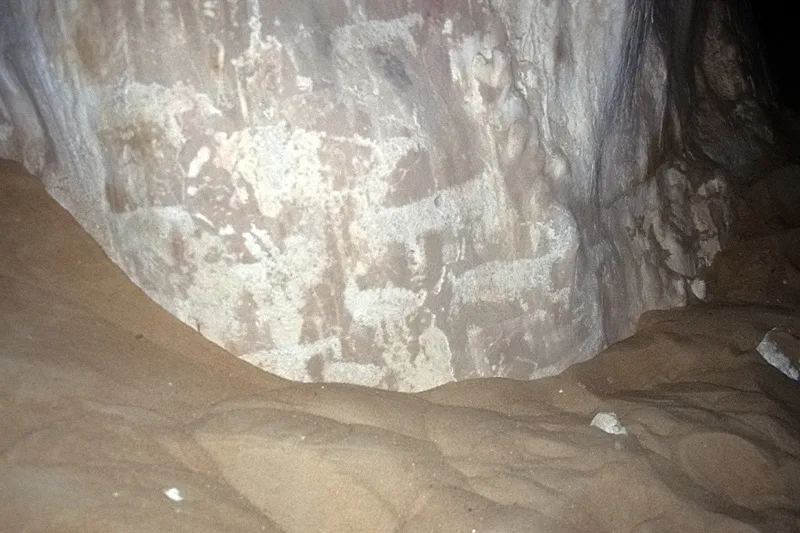
The cave is entered down a steep, sandy slope from a shallow hollow in the plateau. Inside, the floor is mostly soft sand and the roof hangs with dripstone formations. These grew in far older and wetter periods; today there is too little rain for them to grow.
The engravings are in the upper part of the cave, in the area known as the Hall of the Gazelles, and on a large stalagmite. They were cut or pecked into the rock and are strongly stylised, so many animals are hard to identify. Ostriches and human figures are clear, and researchers have also recognised animals that may be oryx, addax, gazelles and ibex. The exact age of the art is not known, but the dates from the settlements around the cave suggest it belongs to the same mid-Holocene period.
In October 2026 Egypt’s environment ministry announced moves to make the cave a natural protected area.
Visiting tips
- There is no ticket office or visitor centre. Djara is visited on organised desert trips in four-wheel-drive vehicles, usually from Bahariya or Farafra and often combined with the White Desert.
- Go with a licensed operator who knows the route. Desert trips need permits, which the operator arranges, so carry your passport.
- The cave is dark. Bring a good torch, and expect a steep scramble down sand at the entrance.
- Look at the engravings without touching them, and keep off the dripstone formations.
Getting there
Djara is far from any road and town, out on the open plateau, so the only practical way to visit is with a desert tour operator. Most trips leave from Bahariya or Farafra and spend at least one night camping in the desert, often taking in the White Desert on the same journey.
Last checked November 2026. Sources: uf.phil.fau.de, uni-koeln.de, books.ub.uni-heidelberg.de, showcaves.com, egypttoday.com.
Information card
At a glance
Arabic nameكهف الجارة
GovernorateNew Valley
TicketsNo ticket office; visited only on organised desert trips with a licensed operator.
EraPrehistoric
Prices and hours change often. Confirm on the Ministry’s official site egymonuments.gov.eg before you go.
Frequently asked questions
Where is Djara Cave?
On the Abu Muhariq plateau in the Western Desert, roughly halfway between Assiut in the Nile Valley and the Farafra Oasis.
What can you see in Djara Cave?
Stalactites and stalagmites, and prehistoric engravings of ostriches, human figures and other animals that may be antelopes, gazelles and ibex.
How old is the rock art in Djara Cave?
Its exact age is unknown. Settlements around the cave have been dated to roughly 8,600 to 6,000 years ago, and the art is thought to belong to the same period.
Who discovered Djara Cave?
The German explorer Gerhard Rohlfs reached it in 1873. It was found again by Carlo Bergmann in 1989 and later studied by archaeologists from the University of Cologne.
How can I visit Djara Cave?
On an organised four-wheel-drive desert trip with a licensed operator, usually from Bahariya or Farafra. There is no ticket office at the cave.
Can I combine Djara Cave with the White Desert?
Yes. Many multi-day desert trips visit both, camping out in the desert along the way.