Hierakonpolis (Nekhen): city of the falcon
History Topic
Hierakonpolis, ancient Nekhen, was one of the most important places in Egypt before the pharaohs. It lies on the west bank of the Nile between Esna and Edfu, south of Luxor, and was a major town through the Naqada period, about 4000–3000 BC. Its temple produced the Narmer Palette, and its cemeteries hold the earliest painted tomb in Egypt. Few sites tell the story of how kingship began so clearly.
Where and when
The Greek name Hierakonpolis means “city of the falcon”, after Horus, the falcon god worshipped here. The Egyptian name was Nekhen. Across the river stood Elkab, ancient Nekheb, home of the vulture goddess Nekhbet. Together the two towns were closely tied to the kingship of Upper Egypt.
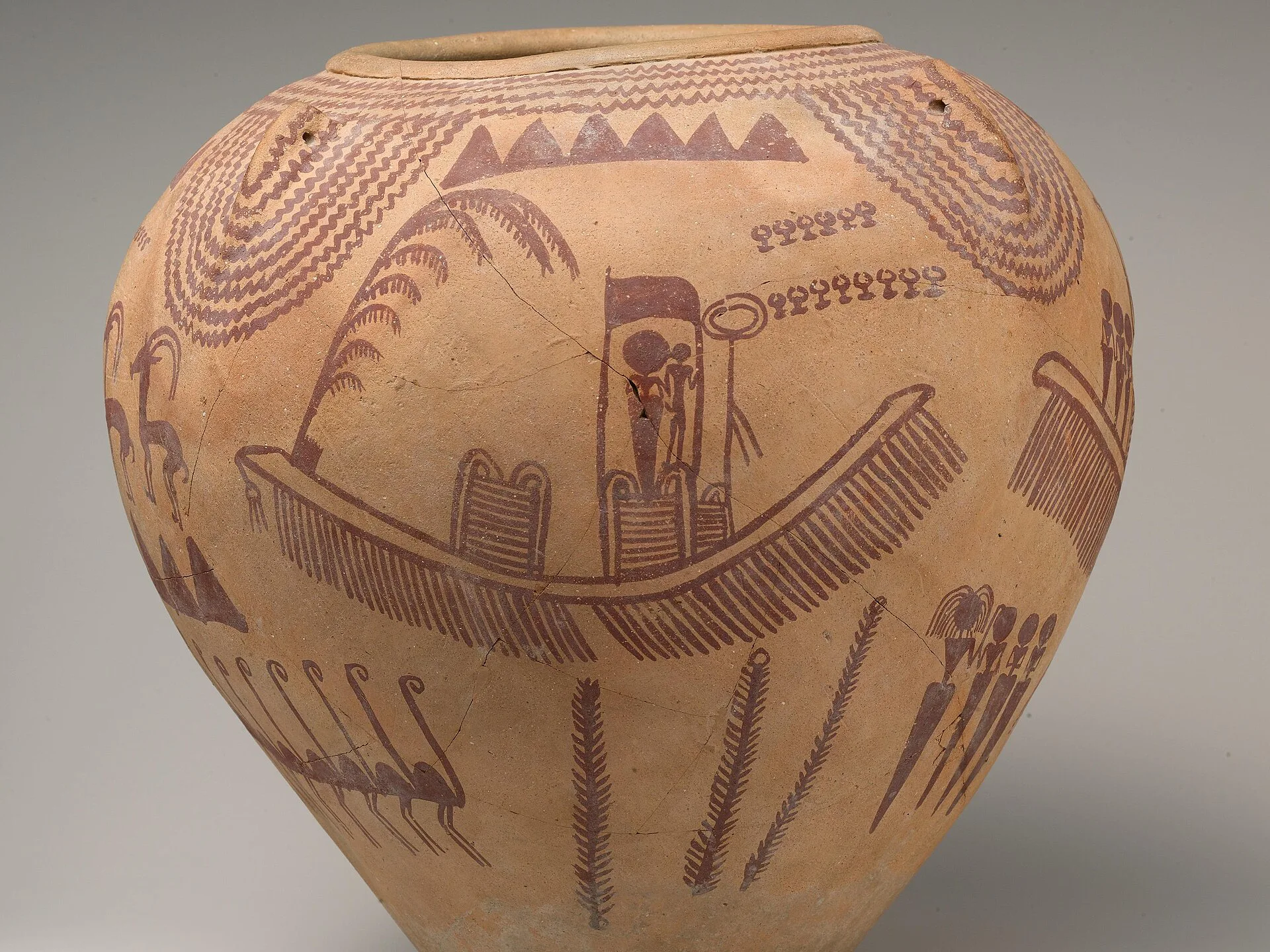
The site spreads over a large area, from the floodplain town of Kom el-Ahmar back into a desert wadi where Predynastic villages, workshops and cemeteries survive. People lived here from before the Naqada period, but the town reached its height in Naqada II and III, part of the wider Naqada culture.
What was found at Hierakonpolis?
Hierakonpolis is best known for the Narmer Palette, found in the temple area in the 1890s. This carved slate palette shows King Narmer wearing the white crown of Upper Egypt on one side and the red crown of Lower Egypt on the other, and is often linked with the unification of Egypt around 3100 BC. It is one of the key objects of Egyptian history.
The Main Deposit
The palette came from a cache in the early temple known as the Main Deposit. Alongside it were the ceremonial mace heads of Narmer and of a king known as Scorpion, the Two Dog Palette, carved ivories and many other votive objects. These were offerings that had been buried together, probably when the temple was rebuilt.
Tomb 100, the Painted Tomb
Tomb 100 is a brick-lined tomb of Naqada II date whose plastered wall was painted with boats, animals, hunters and fighting figures. One scene shows a figure holding down captives, an image later used for pharaohs smiting enemies. It is the earliest known painted tomb in Egypt. The painting was removed and taken to the Egyptian Museum in Cairo, and the tomb’s exact location has since been lost.
The elite cemetery
Modern excavations have explored an elite cemetery known as HK6, used by the town’s leaders. Alongside large tombs were burials of animals, including elephants, hippopotamuses, wild cattle and baboons, which may have been kept by the elite. Other work has uncovered a ceremonial centre, houses, kilns and some of the earliest known large-scale brewing installations.
From a later age, a huge mud-brick enclosure of the Second Dynasty king Khasekhemwy still stands in the desert, one of the oldest standing brick structures in Egypt.
How it was discovered
James Quibell and Frederick Green excavated the town and temple in the late 1890s, finding the Main Deposit and, in 1899, Tomb 100. Their methods were limited by modern standards and records of where things were found are incomplete. Since 1967 the Hierakonpolis Expedition, first led by Michael Hoffman and later by Renée Friedman, has studied the site in detail, mapping desert settlements and cemeteries that the early diggers never reached.
Why it matters
Hierakonpolis shows a Predynastic town growing rich and powerful, with leaders who built large tombs, kept exotic animals and made offerings to a falcon god. Many symbols of later kingship appear here first. It belongs at the heart of the story told in our Predynastic Period overview, which began with the first farmers of the Nile.
Where to see it today
Hierakonpolis is an active archaeological site, mostly low mounds and desert, and it is not set up for regular visitors. Elkab across the river is easier to visit, with rock-cut tombs of the early New Kingdom. The famous finds are in museums. The Narmer Palette and the Tomb 100 painting belong to the Egyptian Museum in Cairo, while the Scorpion and Narmer mace heads and the Two Dog Palette are in the Ashmolean Museum in Oxford.
Last checked November 2026. Sources: Wikipedia, Hierakonpolis, Wikipedia, Narmer Palette, Britannica, Hierakonpolis, Hierakonpolis Expedition.
Information card
Frequently asked questions
Where is Hierakonpolis?
Hierakonpolis, ancient Nekhen, is on the west bank of the Nile between Esna and Edfu in southern Upper Egypt. The town of Elkab, ancient Nekheb, lies across the river.
Where was the Narmer Palette found?
The Narmer Palette was found at Hierakonpolis in the 1890s by James Quibell and Frederick Green. It came from a cache of temple offerings known as the Main Deposit.
Can you visit Hierakonpolis?
Hierakonpolis is an active excavation site with mostly low mounds and is not set up for regular visitors. Its best-known finds are displayed in the Egyptian Museum in Cairo and the Ashmolean Museum in Oxford.