El Omari is a Neolithic farming culture named after a group of settlement sites near Helwan, on the east bank of the Nile just south of Cairo. It dates to roughly the middle of the fifth millennium BC, often given as about 4600 to 4400 BC. El Omari matters because it links the earliest northern farmers of the Faiyum and Merimde with the later Maadi culture, and it shows how Lower Egypt developed in its own way before the south took over.
Where is El Omari?
El Omari is near Helwan, on the east side of the Nile south of central Cairo, close to where Wadi Hof opens towards the river. The settlements sat on higher ground at the mouth of the wadi, near the edge of the floodplain.
Dating El Omari precisely has been difficult, and different studies place it slightly differently within the fifth millennium BC. It is usually placed after Merimde’s main phases and before the Maadi culture.
How people lived
The people of El Omari were farmers. They grew emmer wheat and barley and kept animals such as sheep, goats, cattle and pigs. Fish from the Nile and wild animals hunted in the desert and along the river added to their diet.
Their homes were simple oval huts, made with posts and reed or wattle walls, often with a hearth inside or nearby. Next to the houses were storage pits, some lined with baskets or mats, used to keep grain and other food. This mix of huts and pits is typical of the early farming villages of northern Egypt.
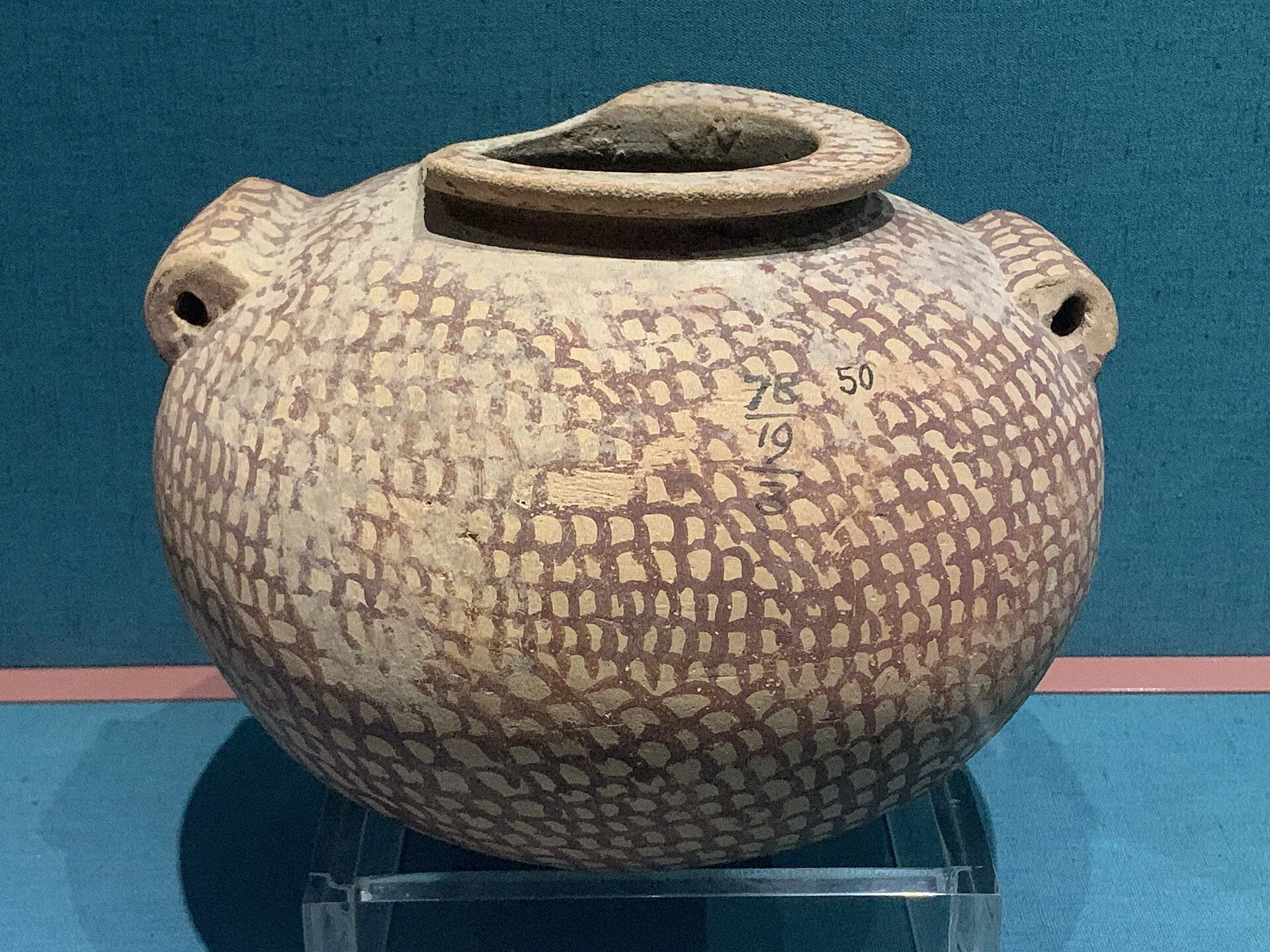
The pottery is mostly plain and undecorated, in red or black, sometimes polished, in simple bowl and jar shapes. The villagers made flint tools such as sickle blades, scrapers and arrowheads, and they made simple ornaments from shell and stone.
Burials and beliefs
As at Merimde, the dead at El Omari were buried within the settlement, close to the houses, rather than in a separate cemetery. Bodies were placed in a contracted position in simple oval pits, with few objects. A pot was sometimes placed in the grave. These burials suggest a sense of care for the dead and of keeping them close to the living, though little is known about the beliefs behind them.
How it was discovered
The site takes its name from Amin el-Omari, the young Egyptian scholar who discovered it in the 1920s and who died before he could excavate it. The main excavations were carried out in the 1940s and early 1950s by Fernand Debono for the Egyptian Antiquities Service. The full results took decades to appear, which is one reason El Omari is less well known than Merimde or the Faiyum.
Why it matters
El Omari helps fill the gap in northern Egypt between the earliest farming villages and the Maadi culture. Its houses, pits and settlement burials have much in common with Merimde Beni Salama, while some features point forward to the Maadi–Buto culture that followed in the same area. Together these sites show a northern tradition with its own customs, quite separate from the Badarian and Naqada cultures of the south. The full story is set out in our overview of Egypt’s first farmers.
El Omari also shows how close prehistory lies to modern Cairo. The same stretch of the Nile valley, a short drive from the city centre, was home to farming families more than six thousand years ago.
Where to see it today
There is little to see at El Omari itself. The area near Helwan has changed a great deal through modern building and industry, and the site is not set up for visitors. Finds from northern farming cultures like this one are best looked for in the collections of major Egyptian museums, where predynastic material is usually shown together.
Last checked November 2026. Sources: Wikipedia: Prehistoric Egypt, Britannica: Ancient Egypt.
Information card
Frequently asked questions
Where is the El Omari site?
El Omari is near Helwan, on the east bank of the Nile south of Cairo, close to the mouth of Wadi Hof. It lies within the modern Cairo region.
How old is the El Omari culture?
The El Omari culture dates to the middle of the fifth millennium BC, often given as about 4600 to 4400 BC. Exact dates are still discussed.
Who excavated El Omari?
The main excavations at El Omari were carried out by Fernand Debono for the Egyptian Antiquities Service in the 1940s and early 1950s. The site is named after Amin el-Omari, who discovered it.