Faiyum Neolithic: Egypt’s first farmers by Lake Qarun
History Topic
The Faiyum Neolithic, also called the Faiyum A culture, is one of the earliest farming cultures in Egypt. It grew up along the northern shore of the ancient lake in the Faiyum depression, the ancestor of today’s Lake Qarun, from about 5200 to 4200 BC. Its people were among the first in Egypt to grow wheat and barley and keep sheep and goats, and the grain pits they left behind are some of the oldest evidence of farming in the country.
Where and when
The Faiyum is a large basin in the Western Desert, south-west of Cairo, fed by a branch of the Nile. In prehistoric times its lake was far larger and fresher than the salty Lake Qarun of today, and its shores were rich in fish, birds and game.
Hunter-fisher groups had used the lake shore before farming arrived; archaeologists sometimes call this earlier phase the Qarunian or Faiyum B. The farming culture appears from about 5200 BC, and it lasted for roughly a thousand years. Exact dates vary between studies, as they do for most of Egyptian prehistory.
Is the Faiyum Neolithic the oldest farming culture in Egypt?
The Faiyum Neolithic is among the oldest known farming cultures in Egypt, together with Merimde Beni Salama on the edge of the Delta. Earlier sites in the Western Desert show herding and pottery, but the Faiyum gives some of the earliest clear evidence of cultivated wheat and barley in Egypt.
How people lived
The people of the Faiyum grew emmer wheat and barley, crops that had been domesticated in Southwest Asia and reached Egypt from there. They kept sheep and goats, and probably cattle too. Even so, the lake remained central to their lives. Fish bones are common at the sites, and people also hunted animals and birds around the shore.
Their most famous remains are their storage pits. On higher ground away from the settlements, people dug groups of pits and lined them with basketry or straw matting to keep their grain dry. Some still held preserved grain when they were excavated, which gave early proof that the Faiyum villagers were farmers.
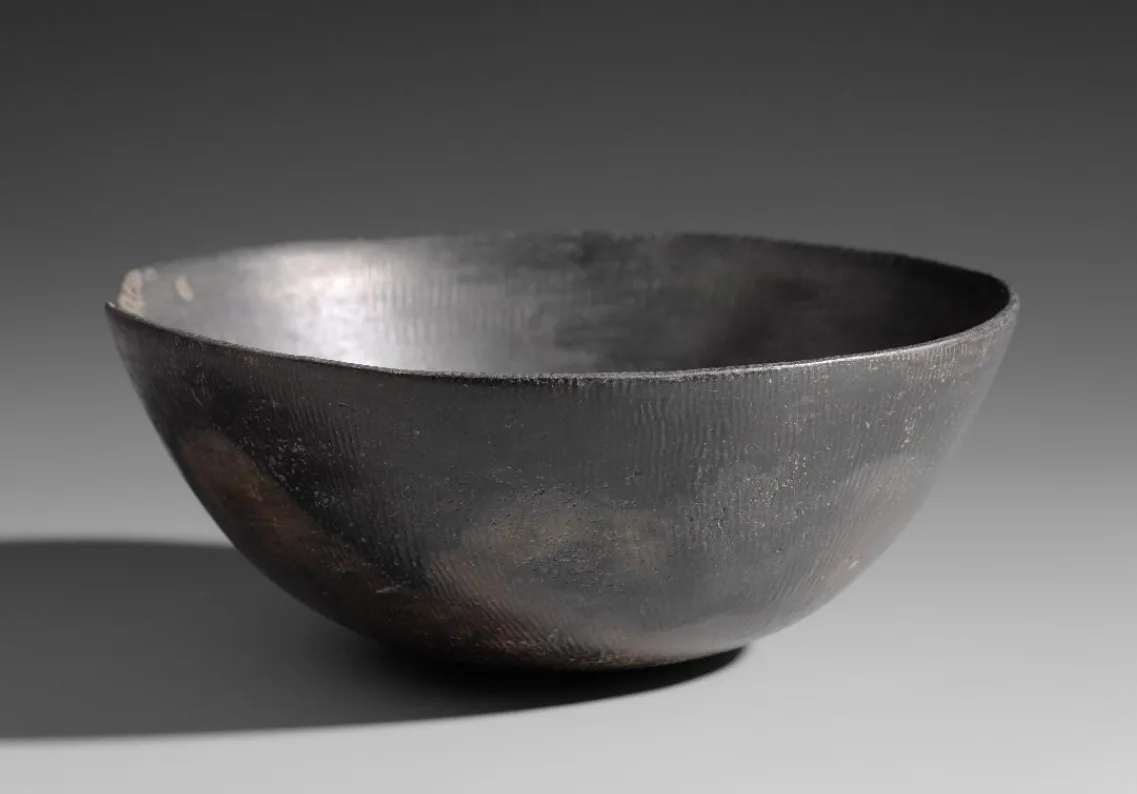
Traces of solid houses are scarce. The settlements are known mainly from hearths, scattered tools and rubbish, which suggests light shelters, and perhaps a way of life that moved around the lake shore with the seasons. Pottery was simple and coarse, usually plain, made in basic bowl and pot shapes.
The stone tools are much better made. The Faiyum people produced fine bifacial flint tools, including arrowheads with concave bases, axes and sickle blades with serrated edges for cutting cereal stalks. They also made baskets and mats, some of which survived in the dry sand.
Burials and beliefs
Very little is known about how the Faiyum people treated their dead. Few or no burials have been clearly linked to the culture, so their beliefs remain mostly unknown.
How it was discovered
The Faiyum Neolithic was identified in the 1920s by the British archaeologist Gertrude Caton-Thompson and the geologist Elinor Wight Gardner. Working on the north shore of the lake, they recorded the settlement mounds and the groups of grain pits, and they studied how the lake had changed in size over time. Their two-volume report, The Desert Fayum, was published in 1934 and is still a standard reference. Later teams have returned to the area to study the sites with modern methods.
Why it matters
The Faiyum sites show farming at an early stage in Egypt, when grain and herds were added to an older life of fishing and hunting rather than replacing it. They remind us that the switch to farming was slow and mixed. The lined pits are also an early example of something that mattered throughout Egyptian history: storing the harvest to last through the year.
The story continues in the Delta at Merimde Beni Salama, and the wider picture is in our overview of Egypt’s first farmers.
Where to see it today
The Neolithic sites on the north shore of Lake Qarun lie in open desert and have little to see for visitors; they are not set up for tourism. The landscape itself is worth the trip, and the Faiyum is an easy journey from Cairo. Finds from early Egyptian farming cultures can be seen in the Egyptian Museum in Cairo and in major museums abroad with predynastic collections, such as the British Museum and the Petrie Museum in London. For the bigger picture, see our page on the Predynastic Period.
Last checked November 2026. Sources: Wikipedia: Faiyum A culture, Wikipedia: Gertrude Caton-Thompson, Wikipedia: Prehistoric Egypt.
Information card
Frequently asked questions
What is the Faiyum A culture?
Faiyum A is another name for the Faiyum Neolithic, a farming culture on the northern shore of the ancient Faiyum lake from about 5200 to 4200 BC. Its people grew wheat and barley, kept sheep and goats and fished the lake.
Who discovered the Faiyum Neolithic?
Gertrude Caton-Thompson and Elinor Wight Gardner identified the Faiyum Neolithic during fieldwork on the north shore of the lake in the 1920s. They published their results in The Desert Fayum in 1934.
Can you visit the Faiyum Neolithic sites?
The sites lie in open desert north of Lake Qarun and have little to see, as they are not set up for visitors. Early Egyptian farming finds are better seen in museums such as the Egyptian Museum in Cairo.